Bobyard, the San Francisco startup known for using AI to read construction drawings and pull quantities, now wants to handle the rest of the bid too. In an Oct. 29 update, the company said its software can carry a job from the plan set to a priced estimate, a branded proposal for the client and, after the job is won, an AI-assembled submittal package (via Bobyard).
The company's release describes how that chain usually works today: quantities come out of a takeoff program, pricing lives in a spreadsheet, the proposal gets built from a template, and submittals are a separate process once the contract is signed. Bobyard's pitch is that all of it can happen in one place.
According to the company, the pieces connect like this. The takeoff side uses trade-specific AI to measure, count and sort quantities off the drawings. Those quantities feed an estimate table that pulls items and assemblies from a cost database the contractor builds once and reuses across bids. The table supports custom columns and formulas and handles tax, overhead, markup and margin. From there, the software generates a branded proposal without exporting to another program.
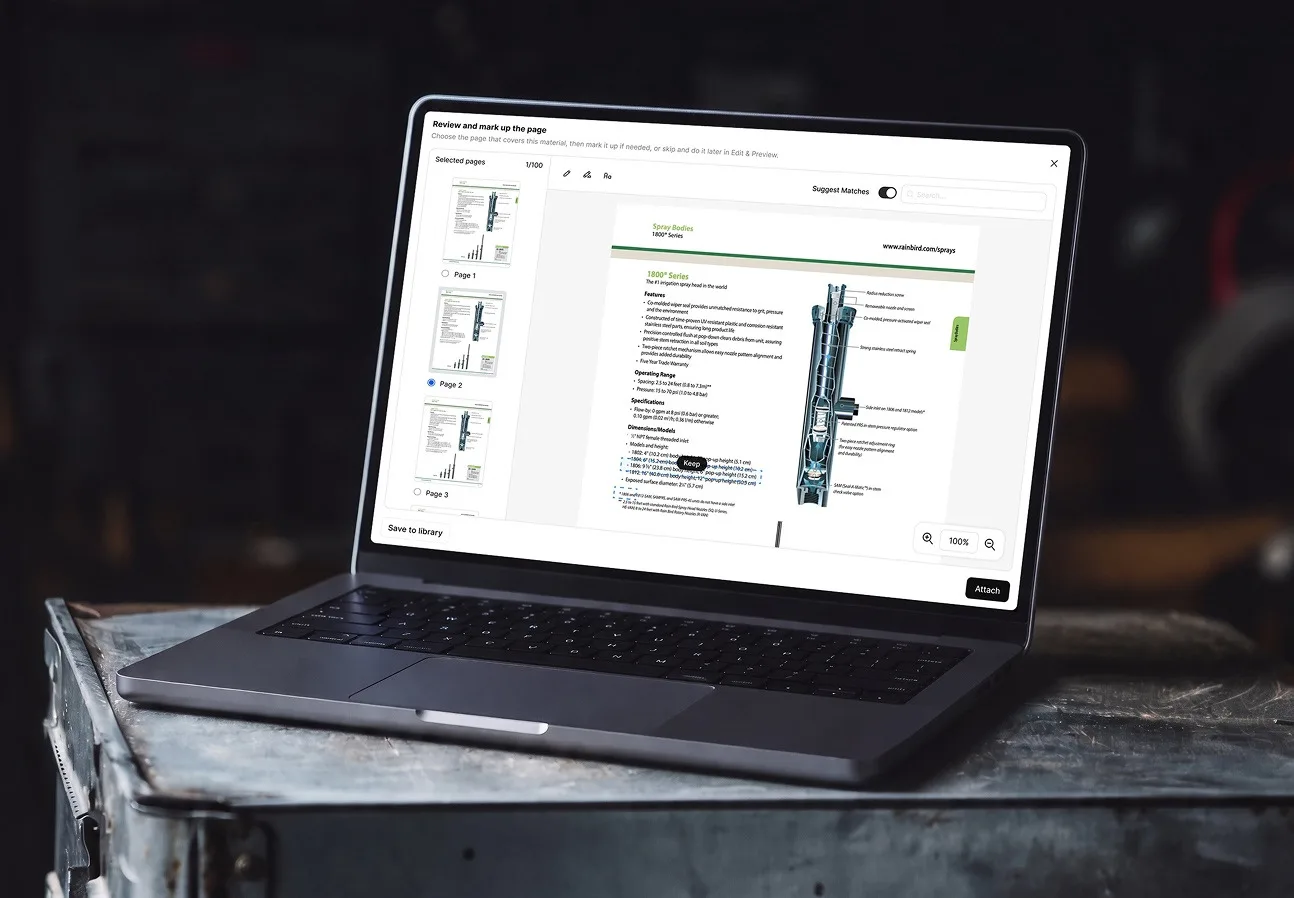
The submittal tool is the newest part. Contractors upload product data sheets and specs, and the AI looks for matching products, flags missing details and assembles a PDF package. The wire version of the announcement says the submittal feature can also be used on its own, without Bobyard's takeoff.
The trade list has grown well past where Bobyard started. Landscaping was its first trade, and the company says the AI takeoff now covers electrical, plumbing and other MEP work, paving and finishes. The wire release says this update also adds drywall, insulation, doors and windows, each with its own symbols, assemblies and takeoff logic.
Speed claims come with a range. Bobyard's own post says customers report takeoffs 50% to 90% faster and that teams send twice as many bids per estimator. The wire release puts the average takeoff time savings at 65% and says customers submit three to five times more bids per estimator. Those are company-reported numbers, not independent tests, and they don't line up perfectly with each other.
Founder and CEO Michael Ding explained the order Bobyard built things in. "We started with takeoff because if you cannot read the drawings, you cannot automate anything that depends on them," he said in the release.
The company was founded in 2023 and went through the PearX startup program, where Pear VC says it raised a $3.5 million round from Primary after demo day. According to the release, Bobyard closed a $35 million Series A in December 2025 led by 8VC.
The labor backdrop is part of the sales pitch. Associated Builders and Contractors estimated in January that the industry needs to bring in about 349,000 net new workers in 2026, mostly to replace retirees. A 2025 Richmond Fed economic brief found that real output per construction worker in 2020 was more than 30% lower than in 1970, while productivity across the broader economy roughly doubled. Estimating doesn't swing a hammer, but a shop that can price more jobs with the same people can be pickier about what it wins.
Neither the company post nor the release lists pricing for the new features. Bobyard is steering interested contractors to book a demo using their own drawings.
Why it matters for Contractors
For a small sub, the estimator is often the owner working nights. If a tool cuts takeoff time anywhere near what Bobyard claims, the real payoff is bidding more work or getting your evenings back, not replacing anyone.
Before you sign up, test it on a job you've already bid by hand and compare the quantities line by line. Ask whether the trades you do are fully supported, how it handles messy or scanned plan sets, and whether you can export your cost database if you leave. Setting up items and assemblies takes real time up front, so the payoff comes from reusing it.
The submittal feature may be the quickest win for shops that hate paperwork. Pulling cut sheets and checking them against the spec is tedious, but an AI-built package still needs a person to review it before it goes to the GC or architect.