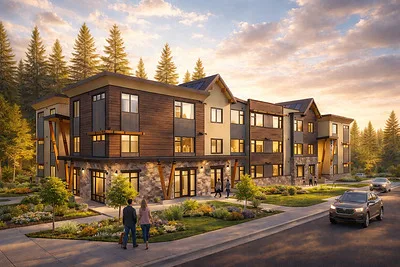
FRISCO, Colo. — Two housing projects in this Summit County mountain town hit major milestones in the same week, adding 106 homes for local workers and lower-income households.
The NHP Foundation, a national nonprofit housing developer, opened The Scout, 54 workforce apartments at 602 Galena St., on Sept. 25. Three days earlier, on Sept. 22, it broke ground on The Bella, 52 affordable apartments at 101 W. Main St. The developer announced both milestones Sept. 29.
The Town of Frisco invested about $13 million across the two projects: roughly $8.1 million in The Scout, on top of buying the land, and about $4.9 million in soft financing for The Bella.
The Scout: housing for the local workforce
The Scout is NHPF's first development in Colorado. It's aimed at middle-income workers who often earn too much for traditional affordable housing but too little to afford market rents in a resort town.
- 54 all-electric apartments: 22 studios, 20 one-bedrooms and 12 two-bedrooms
- Rents capped at 120% of Summit County area median income
- Starting rents of about $2,001 for a studio, $2,223 for a one-bedroom and $2,660 for a two-bedroom, according to the town
- Residents must work at least 30 hours a week, year-round, in Summit County, with priority for people who work in Frisco
The site once housed state offices. The town bought it in 2022 with $1 million in help from Summit County.
The Scout's financing included:
- $8.1 million from the Town of Frisco, plus the land
- $2.8 million in infrastructure grants from the Colorado Department of Local Affairs' More Housing Now and Strong Communities programs
- $18.6 million in 501(c)(3) bonds from the Colorado Middle-Income Housing Authority, its first bond deal, with repayment guaranteed by NHPF
Gov. Jared Polis said The Scout "delivers 54 new apartments for the workers and families who keep Frisco running."
The Bella: tax-credit housing on Main Street
The Bella is NHPF's first Low-Income Housing Tax Credit development in Colorado and its second project in Frisco. It replaces 1970s-era office space at 101 W. Main St.
- 52 apartments: studios, one-bedrooms and two-bedrooms
- Rents for households earning 30%, 50% and 80% of area median income, averaging 60% AMI
- Completion expected in November 2027
The town approved a density bonus that, according to NHPF Senior Vice President Neal Drobenare, "tripled the site's development capacity and allowed for more parking." When the site first received a state land-banking grant, the project was planned for at least 45 units.
The town will own the land permanently, and the homes are meant to stay permanently affordable. Frisco also plans to buy a small commercial space in the building once it's finished.
The Bella's financing includes:
- About $4.9 million in soft financing from the Town of Frisco, plus a property tax abatement
- A $5 million Proposition 123 land-banking grant from the state, which the town helped secure
- Two state infrastructure grants and Colorado Division of Housing grants
- 9% federal and Colorado state low-income housing tax credits, allocated through the Colorado Housing and Finance Authority
- A construction loan from U.S. Bank and a permanent loan from Cedar Rapids Bank & Trust
Demolition began Aug. 25, about four weeks before the formal groundbreaking.
What they said
Drobenare said "Frisco did far more than support these developments; the Town helped make them possible."
NHPF President and CEO Eric Price said the two projects expand housing "so families can live where they work."
Frisco Mayor Rick Ihnken called The Scout an example of "what can happen when local and state partners come together around a shared need."
Why it matters
Analysis: Frisco's approach offers a template for other mountain towns. The town controls the land, uses its own money to fill financing gaps, and grants zoning relief like density bonuses. That lets a nonprofit developer layer state and federal sources on top.
The two projects also cover different parts of the income ladder. The Bella serves lower-income households through tax credits. The Scout serves workers up to 120% AMI, a group most federal programs don't reach, using a newer state tool: the Middle-Income Housing Authority's tax-exempt bonds.
For contractors, mountain projects like these bring their own challenges: short building seasons, high labor and lodging costs, snow loads and tight downtown sites. Towns across Summit County and the I-70 mountain corridor continue to push for workforce housing, so similar public-private projects are likely to keep coming. Neither release named a general contractor or architect.