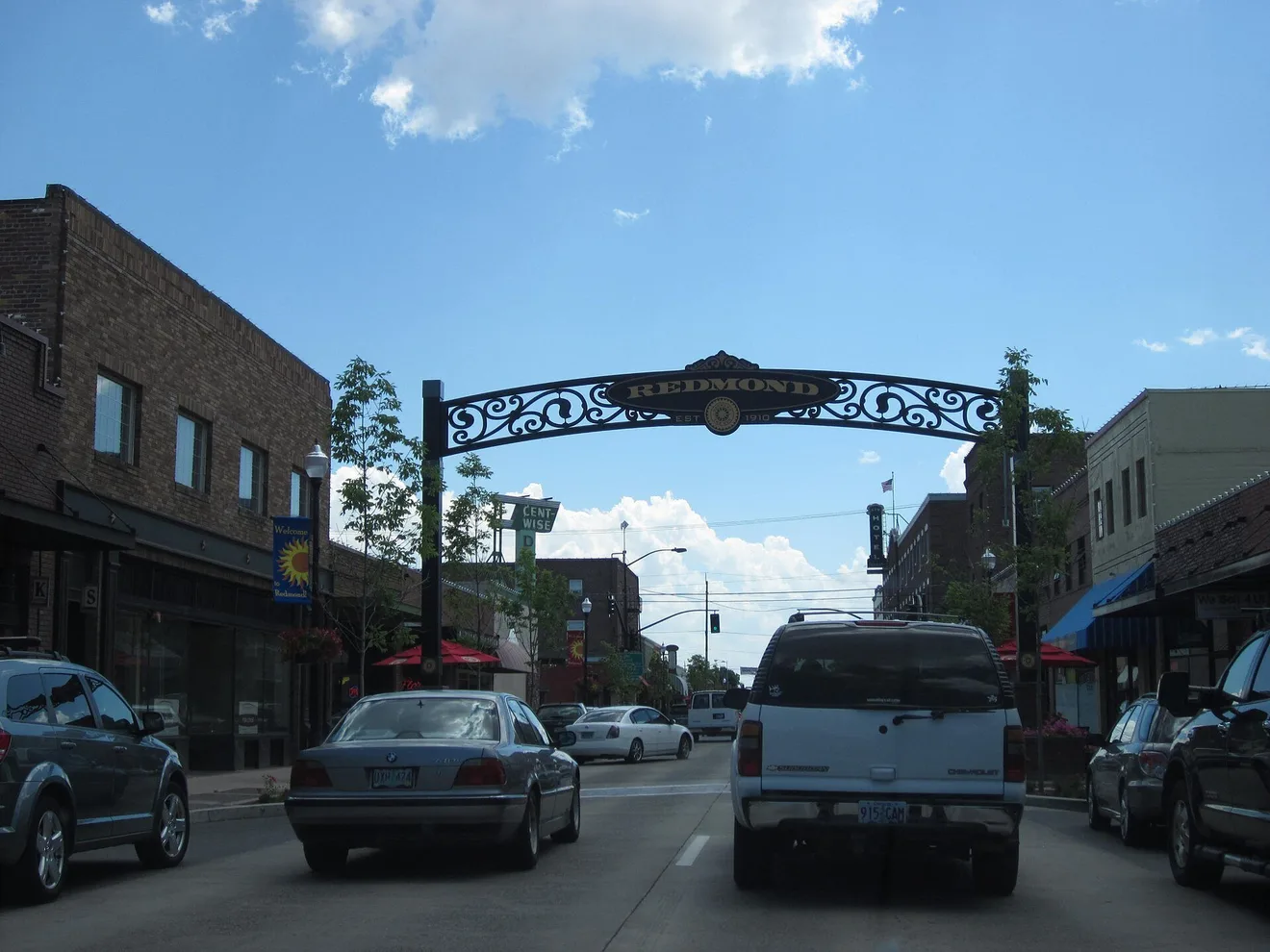
A Redmond builder's 16-unit modular rental community off 15th Street has some neighbors upset, and city officials say state housing law didn't leave them room to block it (via Redmond Spokesman).
Timbergon Modular's Canyon Cottages sit along Dry Canyon in a mostly single-family neighborhood. Each unit is 540 square feet with a studio-style layout and rents for $1,595 a month, utilities included. Units come with a refrigerator, microwave, stovetop, washer and dryer, plus solar panels on the roofs. Each gets one designated parking space, and renters can pay for extra storage.
The cottages opened earlier this month, with a showing and ribbon-cutting on Nov. 12, according to the Spokesman. The paper classifies them as cottage clusters and calls the project Timbergon's second ADU-style development in Redmond. Developer Vicente Gonzalez had previously told the paper the company built a three-unit community on Reindeer Avenue. Gonzalez declined to comment for this story.
Timbergon isn't just a cottage outfit. The Spokesman reports it has also built a 20-unit building on Fourth Street south of Walmart and a nine-unit building at Fifth Street and Fir Avenue. Talks are underway to buy the neighboring property and add 14 more cottages, though that sale is still being negotiated.
On its website, the Redmond-based company says its ADUs are built indoors in a factory, set on permanent foundations and built to state and local codes. It claims modular units reach occupancy 30 to 50 percent faster than site-built construction. Site work, foundations and utilities are typically handled by a general contractor, and Timbergon says it offers turnkey service through partner Lar-Moon Restoration and Construction or can work with an owner's own contractor.
Next door, the reaction has been mixed. Jeff and Linda Givens have five of the homes backing onto their yard. They spent $8,600 on an 8-foot fence, they're on a fixed income, and they estimate the development has knocked $100,000 to $150,000 off their home's value, the Spokesman reported. "High density neighborhood. That's what this stuff's kind of for — around apartments and four-plexes, that kind of thing," Jeff Givens said. Linda Givens said, "It's depressing, but it's better now that we have that fence."
Meredith Lees, who lives across 15th Street, worries about traffic. "That's a lot of coming and going from a little area like that onto a street that already has gotten rather busy," she said. Lees started a petition this summer to protect Siberian elms on her property. The paper notes that some neighbors see the project as progress.
So why couldn't the city step in? Planning Director Kyle Roberts told the Spokesman by email that recent state law changes require local governments to amend zoning codes to allow middle housing and make permitting easier. House Bill 2001 requires Redmond to outright permit middle housing types, including plexes, townhouses and cottage clusters, in all residential zones. That's the large-city version of the law, which the state Department of Land Conservation and Development says applies to cities over 25,000 outside the Portland metro.
Senate Bill 1537 requires the city to grant exceptions to development and design standards when an application meets certain conditions. According to a DLCD summary, qualifying projects can get up to 10 adjustments, including full relief from parking minimums and facade standards, up to 10 percent off side or rear setbacks and up to 25 percent less open space. The Spokesman didn't say whether Canyon Cottages used any of those adjustments.
Mayor Ed Fitch isn't a fan of the state rules. "I'll call it micromanagement from the legislature," he said. His main concern with Canyon Cottages is parking: there's no parking on 15th Street, and one space per unit doesn't cover guests.
Why it matters for Contractors
This is what by-right middle housing looks like on the ground in Central Oregon. If your plans meet the code, a city like Redmond can't say no just because neighbors object. That makes small-footprint rentals and cottage-style infill a more predictable bet for small builders, especially paired with factory-built units that cut site time.
But predictable approval doesn't mean a quiet build. Neighbors still show up in the paper, and parking, fences and trees on adjacent lots can turn into a fight. If you take on a project like this, budget for good screening, plan parking honestly, and talk to the neighbors early. If you're a GC who handles site work, modular ADU suppliers that rely on local contractors for foundations and utilities could be a source of steady work.