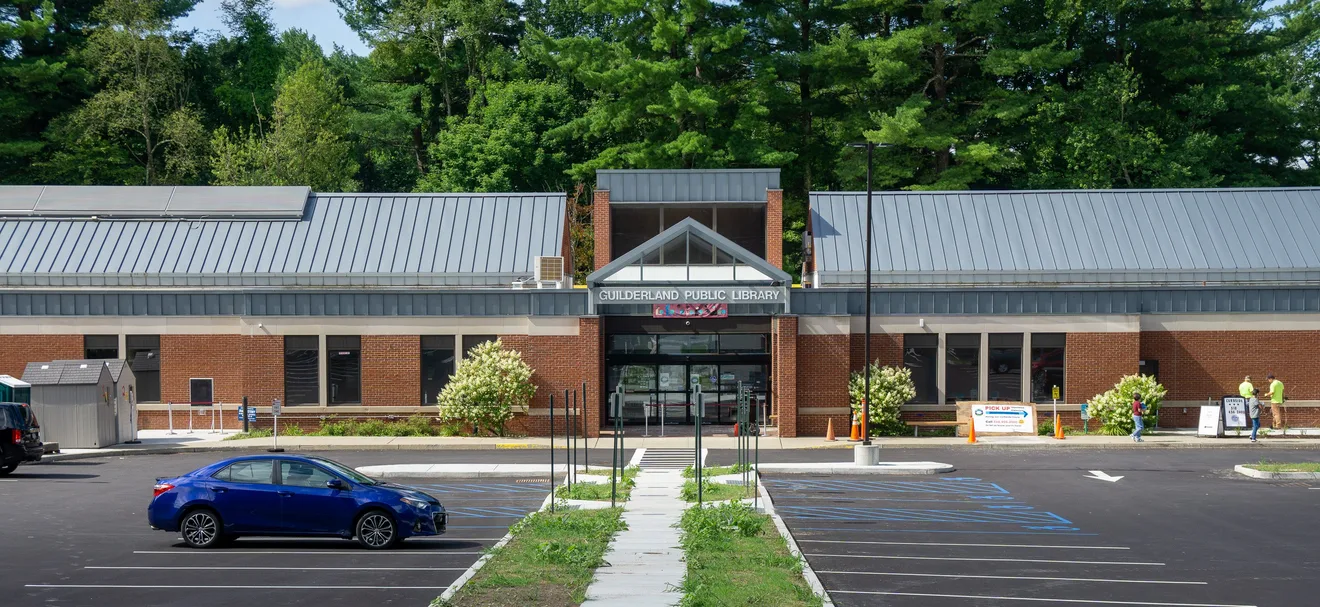
Guilderland's town board on Tuesday, Oct. 20, adopted a local law rezoning about 10.7 acres at 6 and 10 Mercy Care Lane, near the town's public library, for a 72-unit affordable and workforce housing project from Rockabill Development (via The Altamont Enterprise). The two parcels move from single-family R15 zoning to a Planned Unit Development district.
Don't mistake it for a groundbreaking, though. The rezoning is one step in a multistage review. The planning board had already given the project preliminary site-plan approval, and the developer has said all along that the job hinges on state money.
According to the Enterprise's reading of the new law, the plan calls for five buildings: two two-story townhouse buildings with four units apiece, two three-story buildings with 20 units each, and one three-story building with 24 units. Height is capped at 36 feet. Elevation drawings in the town board's Oct. 20 meeting packet, prepared by LaBella Associates for Rockabill, show the tallest building topping out right at that mark, with the townhomes and the other three-story buildings coming in lower.
Eight in ten units would be affordable, aimed at households earning 30 to 60 percent of area median income. The other 20 percent would be workforce units for households at 80 percent of AMI. The Enterprise has previously reported that works out to roughly $30,000 to $90,000 a year in Guilderland.
The law also requires a sidewalk along Mercy Care Lane from the site to Winding Brook Drive. Before building permits are issued, Rockabill has to pay a parkland assessment of $2,200 per townhome unit and $1,200 per multifamily unit, plus water and sewer connection fees. With eight townhomes and 64 apartments, the parkland piece alone comes to about $94,400.
And there's a clock on it. If an active building permit isn't issued within three years of the law taking effect, the land reverts to single-family zoning, unless the town board grants a one-year extension.
This isn't the first housing plan for the site. An earlier project, Beacon Meadows, was planned there as a 65-unit intergenerational development; a 2020 town board agenda listed, and then postponed, a payment-in-lieu-of-taxes agreement for it. Members of the development team told the Enterprise in December 2024 that Beacon Meadows couldn't land state funding because of the age restrictions placed on it.
The current plan needed an exception to the town's moratorium on certain residential development, which the board granted so Rockabill could chase state funding. In August of last year, the board unanimously signed off on the 72-unit density. Supervisor Peter Barber was clear at the time that it wasn't final approval: "We are not setting the building height," he said. "We're not giving any permission for anything."
This August, the board voted 5-0 to issue a negative declaration under the State Environmental Quality Review Act, meaning no full environmental impact statement was required. The planning board then granted preliminary site-plan approval.
Not everyone was on board. Former councilwoman Laurel Bohl, who owns adjoining property, argued the project didn't meet the PUD's public-use standard because its clubhouse would serve residents rather than the public. A town planner's memo updated in August said Rockabill had expanded the clubhouse to include co-working space open to the public. The adopted law lists a community-center building but doesn't require public access, and the Enterprise reported it's unclear whether the co-working plan survives.
P. Christopher Dirr, a Rockabill principal, told the board in June 2025 that the project depended on New York State Homes and Community Renewal's annual 9-percent tax-credit round, and that July 2026 was the earliest construction could start if funding came through. In August, he said the project was aimed at this year's HCR round, with applications due in early September. Neither the Enterprise's coverage nor the town packet says whether an award has been made.
Why it matters for Contractors
For now this is a project to watch, not one to bid. The zoning is set, but site-plan review isn't finished and the financing isn't confirmed. The two things to track are HCR's tax-credit award announcements and the Guilderland planning board's agendas for final site-plan approval.
If the money lands, the three-year permit clock gives the developer a reason to move. Five low-rise buildings and a sidewalk along Mercy Care Lane add up to a lot of separate scopes, from sitework and concrete to framing, roofing and finishes. Small shops in the Capital Region who want a piece should get to know the general contractor once one is named, and ask early what paperwork comes with state-financed work so there are no surprises at payment time.