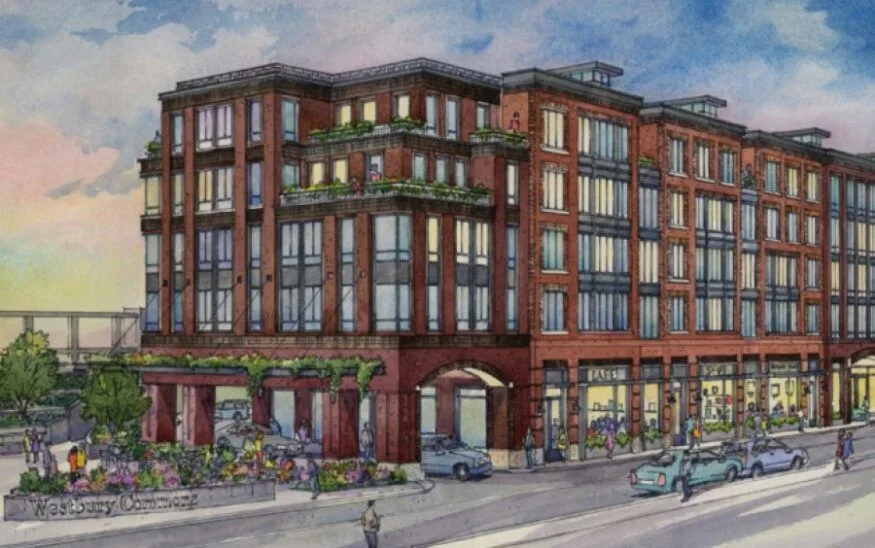
For anybody who builds on Long Island, this one's a big deal. A surface parking lot next to the Westbury Long Island Rail Road station is set to become a five-story, 184-apartment building, and it's the MTA's first transit-oriented development on the Island.
The Westbury Village Board of Trustees voted unanimously to approve the plan from developer Gotham Organization, New York YIMBY reported. The project carries a $100 million price tag.
What's going up
The building will have 184 apartments, with 10% set aside as affordable housing. Plans also call for more than 15,000 square feet of ground-floor retail, 254 parking spaces and a public plaza. The site covers 1.92 acres bounded by Railroad and Post Avenues, right next to the station.
The renderings, credited to the Village of Westbury, show a design meant to look like a collection of separate buildings. The facade is red brick in varying shades around different window arrangements, some with Juliet balconies, and parts of the upper floors step back with setbacks and cutout terraces. Numerous storefronts appear along the ground floor.
Inside, amenities will include a lobby, fitness center, roof terrace with barbecue grills, a multi-sport simulator, a lounge and coworking space.
How the vote went
The Long Island Press reported that trustees approved the project at a public hearing on Thursday, Sept. 3. The applicant was GO Westbury, LLC, an affiliate of Gotham Organization. Before the vote, trustees approved a resolution making the village the lead agency on the project, giving it full say over approval.
That hearing was a continuation of one held Aug. 6, when the public, the MTA and the Westbury Water District weighed in. At the September session, GO Westbury representatives presented mitigation plans that addressed most of the concerns raised in August, according to the Press.
One of those was pedestrian safety. A GO Westbury representative said the team reviewed the intersection of Post Avenue and Union Avenue near the station and settled on putting up "No Pedestrian Crossing" signs there, redirecting people about 400 feet away to cross closer to the crosswalk near the LIRR ticket office.
Mayor Peter Cavallaro said village code requires 10% of the units to be affordable, and that Westbury sets the income test at 80% of AMI, lower than many programs on the Island.
"Long Island is a very high-income and high-cost region, so a lot of 'affordable' housing is 120% of AMI, which means you can make more money and still qualify for it. We wanted to make ours more truly affordable, so we set it at 80%," Cavallaro told the paper.
The land deal
The site is a surface parking lot formerly used by the MTA. The Long Island Press reported it's no longer needed because the MTA built a parking garage across the way.
Gotham won't buy the land. According to New York YIMBY, the developer will sign a 99-year ground lease with the MTA, paying $2.25 million during construction and a $500,000 "capital transaction payment," plus base rent that starts at $500,000 and goes up 12.5% every five years.
The schedule
Gotham has until March 2027 to apply for new building permits, but it intends to file sooner and break ground in the spring, New York YIMBY reported. Construction is expected to take about 20 months, which would put completion around the end of 2028.
Why it matters for Contractors
A five-story, 184-unit building with brick facades, retail at street level, a 254-space parking count and a public plaza is a lot of work packed onto under two acres. Masonry, mechanical, electrical, plumbing and site crews on Long Island will all want to know when Gotham starts lining up bids, and a roughly 20-month build means steady work through 2028 once it gets going.
There's a bigger reason to pay attention, too. This is the MTA's first transit-oriented development on Long Island, and it was set up as a long-term ground lease rather than a land sale. If it gets built on schedule, villages with underused lots near LIRR stations will have a working example to study.
For now, the next thing to watch is the building permit filing. Gotham intends to beat its March 2027 deadline, and a spring groundbreaking would put crews on site well before the end of next year.