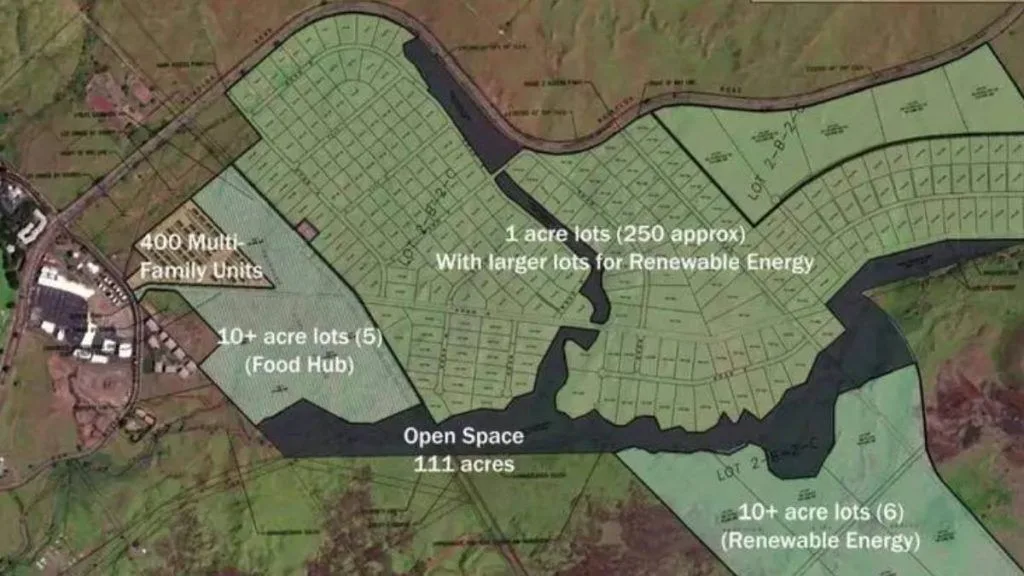
Up in Waikōloa, a big affordable housing plan has run into a big question: is there enough water, and enough road, to support it?
Waikōloa Green would put 400 apartments and 300 single-family homes on 711 acres of former Parker Ranch land, along with a solar panel field, a food hub, a community garden and open space with trails. In June, the Leeward Planning Commission voted 5-0, with one member excused, to send a favorable recommendation forward.
But at the County Council level, the plan stalled. As Big Island Now reported, the council's Committee on Legislative Approvals and Acquisitions spent about two hours on testimony and discussion of Bills 186 and 187 on Oct. 6, then voted 5-3 to give them an unfavorable recommendation. The bills would amend state land use district boundaries to allow a 400-unit multifamily complex with a clubhouse and related improvements.
The fight isn't over. Big Island Now reported that the bills will still be heard by the full council, which can make more amendments.
The project is planned by Waikōloa Green LLC, a partnership between New Jersey developer Daniel Popkin and Jon Yoshimura, an attorney and former state senator and Honolulu City Council member. The company bought the land, south of Waikōloa Road near the Paniolo Avenue intersection, for $4 million from Waikōloa Highlands in 2022.
"We need housing for Hawaiʻi local families," Popkin told the council. "We need to be energy self-reliant. We need to protect open space and cultural resources. Waikōloa Green brings all of these needs together."
The water question
Water was the biggest sticking point. Ciara W.K. Kahahane, deputy director of the state Commission on Water Resource Management, said reported pumping from the Waimea aquifer system is running at 14.458 million gallons a day on a 12-month moving average, or 90.4% of its sustainable yield. If two wells that don't report were pumping at full capacity, the figure would reach 91.1%. And that's before counting Waikōloa Green, for which the commission hadn't received information about total water demand or the source.
"This would bring the total daily draw from the Waimea aquifer to 91% of its sustainable yield per day," Kahahane said.
Popkin and Yoshimura said Hawaiʻi Water Service, a private company that draws all of its drinking water from eight wells in the Waimea aquifer, committed water to the project in a letter dated Aug. 28, 2025.
That didn't settle it for everyone. "Ninety-one percent does not leave us in a place to provide safe, healthy drinking water, especially water necessary in times of a fire," said Council Member Rebecca Villegas.
Getting out in a fire
Evacuation was the other big worry. Most of the testifiers cited infrastructure, including water, evacuation routes and whether Waikōloa Elementary School could handle more students.
Waikōloa Village resident Michelle Stefanik said a second road out of Waikōloa was made a priority 18 years ago and there's still no permanent access road. "During the last wildfire evacuation study, it took approximately 4.5 hours for the last vehicle to evacuate, assuming all roads were open, which is not always the case during a wildfire," she said. Stefanik said she isn't opposed to housing, but wants a cumulative wildfire evacuation study that includes the proposed developments in the area before the project is approved.
Council Member Matt Kanealiʻi-Kleinfelder summed up the committee's mood. "There is a desire for development and growth, but significant issues related to water, fire, schools and roads exist," he said. "These problems will only worsen in the future."
Why it matters for Contractors
A 700-home project would be a huge amount of work on Hawaiʻi Island, from site work, roads and utilities to framing, roofing and finish trades on hundreds of homes and apartments. But the committee vote is a reminder that on much of the island, water and evacuation roads are now deciding whether projects move at all. For contractors, that means two things. First, don't count on this job until the full council acts and the water question is answered. Second, infrastructure itself, from wells and water lines to second access roads, may be where some of the most important work in West Hawaiʻi ends up. Contractors who do civil and utility work should watch how the county and developers answer these questions, because the housing can't come until they do.