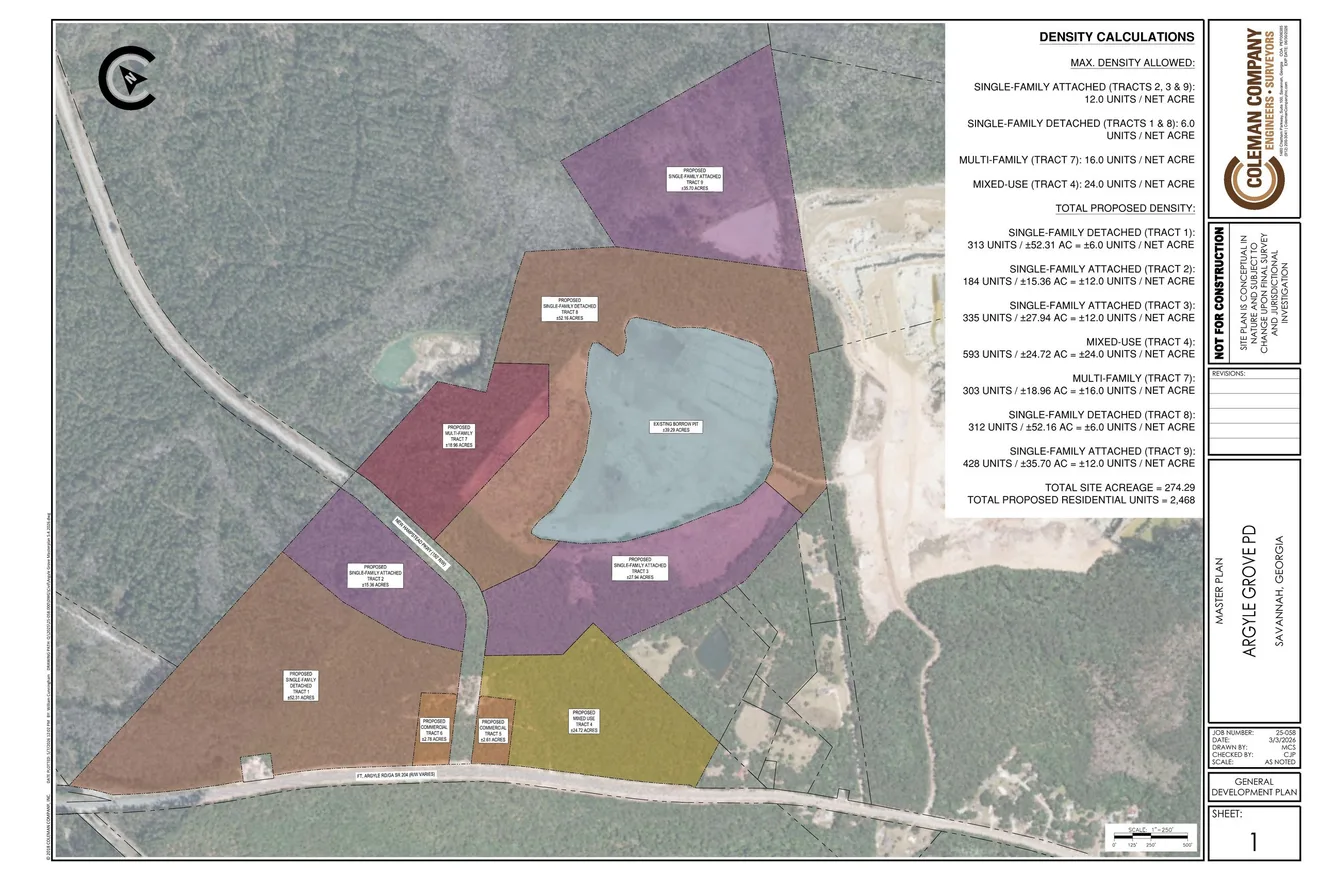
Savannah keeps growing west, and one of the biggest pieces of that growth has a key vote coming up. City Council is scheduled to take up a development agreement on Oct. 22 for a newly annexed property at 0 Fort Argyle Road, where developers plan up to about 2,450 homes.
It's important to be clear about where this stands. The agreement has not been approved. As Urban Savannah reported, the deal is on the council's Oct. 22 agenda, and neither council approval nor construction is established yet.
What's on the table
Back on July 9, council approved annexing the property and rezoning it as a planned development. According to the city's agenda item, the project is proposed to include up to 2,450 homes and about 24,000 square feet of commercial space when it's fully built out in 2038. The developers named in the agreement are Brookhaven Development LLC and Forest Lakes Developers LLC.
The agreement now before council spells out who builds what. The biggest item is a road: the developers would extend New Hampstead Parkway to Fort Argyle Road, running through the property. The city would reimburse them up to $3 million for that roadwork. The developers would also donate about 1.5 acres to the city for future municipal use and pay $500 per home into the Savannah Affordable Housing Fund. City staff recommended approval, and the agenda lists the financial impact as $0, though the agreement itself spells out the up-to-$3 million road reimbursement.
Water and sewer aren't part of this agreement. The city says a separate water and sewer agreement will come to council at a future meeting.
A peek inside the agreement
The draft agreement attached to the agenda has some details worth a contractor's attention.
- The developers pick the builders. The agreement says the owners are responsible for selecting the general contractors and engineering firms for the connector road, and they're allowed to build it in phases.
- Reimbursement comes with paperwork. Each time the developers ask the city for money, they have to include interim lien waivers showing what the general contractor paid its subcontractors the month before. The city is to pay within 30 days.
- The city takes the road over. Once the road is done and approved, the developers hand over the part on their property, and the city maintains it as a public street.
- The $3 million cap can move. The developers can ask to raise the reimbursement limit if they hit unforeseen conditions or the city changes the scope.
- Bonds are waived on some of the early work. The city agrees to waive bonding requirements for platting the connector road, any spine roads on the property and the subdivision of the land.
- Rejected work gets fixed on the owner's dime. If city inspectors reject work as defective, the developers have to correct it at their own cost.
- Wetlands permits may come into play. The agreement notes the connector road may need federal Section 404 authorization, the permit that covers work in wetlands and waters.
- The housing fund money comes at closing. The $500 contribution is due at the first sale of each fee-simple home lot to an outside buyer.
The master plan attached to the agreement shows a mix of housing types, and it tallies 2,468 proposed homes on about 274 acres. By our count from that plan, it breaks down to about 625 single-family detached homes on two tracts, about 947 single-family attached homes on three tracts, 303 apartments and 593 homes in a mixed-use tract. The agenda itself uses the round "up to 2,450" figure, and the plan is labeled conceptual and subject to change.
Why it matters for Contractors
If council approves this deal, a project this size could mean years of work in one corner of Chatham County, starting with roadwork and site development and moving into homebuilding across several housing types. Road builders, utility contractors, grading and site crews would be first in line, and the lien-waiver requirement is a good reminder that subs on the connector road will need clean paperwork to keep payments moving. After that comes the long haul: hundreds of single-family houses, townhome-style attached homes and apartment buildings, which means steady demand for framers, roofers, MEP subs and finish trades. But nothing is final yet. Watch the Oct. 22 outcome and the separate water and sewer agreement before you count on any of it.