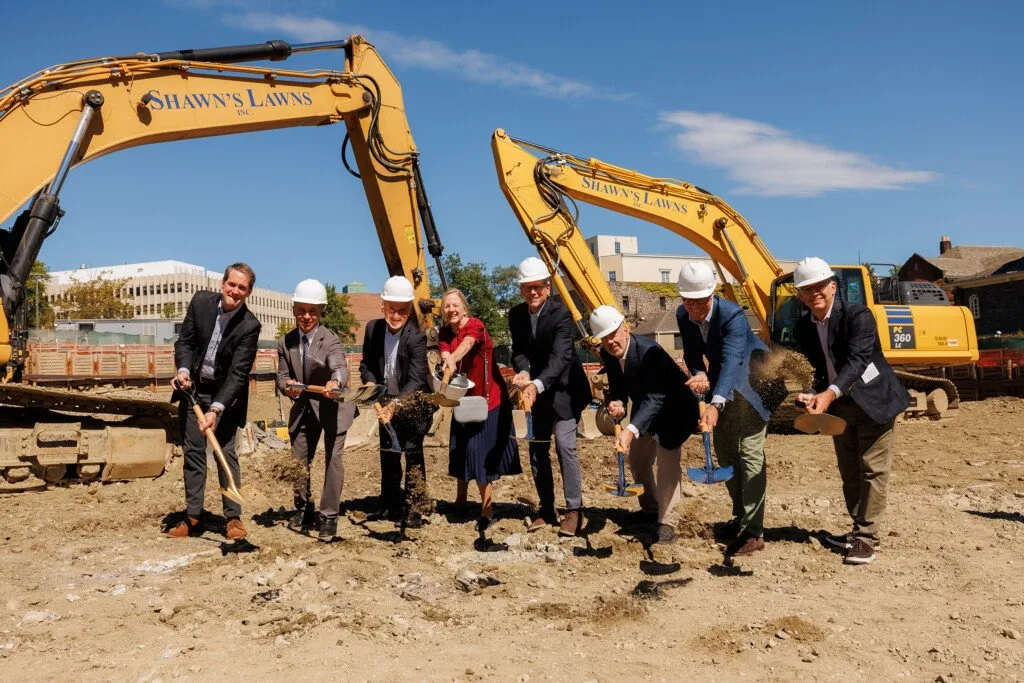
Greenwich doesn't add apartment buildings very often, so when one breaks ground a block off Greenwich Avenue, people notice. Officials celebrated the groundbreaking in September for Benedict Court, a six-story, 120-unit apartment building at 19 Benedict Place, and construction is officially underway, with completion expected in 2028.
"This project represents the largest amount of new housing options coming to the center of downtown Greenwich," said Jamie Anthony, a partner at Lonicera Partners. He said the site sits in an existing high-density commercial zone that town officials pointed to as a sensible place to add housing.
The part getting the most attention is the affordability. Forty-eight of the 120 apartments, or 40%, will be set aside for moderate-income households. The rest will rent at market rates. The goal is to give people who work in town, including teachers, nurses, first responders, town employees and service workers, a chance to live there too. The below-market units will be mixed throughout the building with the same finishes and amenities as everyone else, and they'll stay affordable for 40 years. Developer Joe Tranfo has said the market-rate and below-market units will share the same percentage of one-, two- and three-bedroom apartments, which the zoning commission liked.
That's a big number for Greenwich. The town has about 5.93% of its housing counted as affordable under state rules, well short of the state's 10% benchmark.
Who's building it, and how
The development team is a partnership of Nimbus Properties (Phil Wharton), Benedict Capital (Joe Tranfo) and Lonicera Partners (Jamie Anthony), with Invesco as the institutional equity partner. Santander Bank provided an $88 million construction loan, arranged by Cushman & Wakefield, earlier this year. BKSK Architects of New York designed the building, Redniss & Mead is on the team, and the builder is Ashforth's A.P. Construction.
The site work alone has been a serious job. To clear the way, about a dozen old houses and carriage houses were torn down behind St. Mary Church. Back in June, the Greenwich Free Press toured the site while crews were digging out for two levels of underground parking. They were driving piles, welding supports onto them and sliding steel plates into place for support of excavation. There won't be any surface parking at all. Doing that kind of excavation tight against neighbors, with the residents of Winthrop House next door keeping access to their driveway the whole time, takes real planning.
Once the parking levels are done, the Free Press reported, a lot more workers will be on site and the building will start to take shape. The building is actually two structures separated by a driveway, wrapped in hand-set red brick with varied masonry detailing and historically proportioned windows on the outside, and floor-to-ceiling windows and 10-foot ceilings on the inside. More than half the units will be two-bedrooms and nearly 30% will be three-bedrooms. Amenities include a fitness center, a resident dining room, a library, coworking space and a rooftop terrace with views of Long Island Sound.
Wharton, who has worked through several versions of this project with the town, put his approach plainly: "We have to make it work for the Town," he said. "If you make them an adversary, you're going to have a long and difficult ask."
He also made the case for building here in particular. "It's an infill location, literally sitting in between other buildings," he said. "There's already infrastructure here. It's where the density already is."
Planning and Zoning approved the project in 2024 after several rounds of changes. Wharton said the affordability mix meets the state's 8-30g affordable housing law, and he described it as a new formula worked out with the town for people who earn too much for conventional affordable housing but can't afford Greenwich market rents.
Why it matters for Contractors
Benedict Court is a good picture of where a lot of Fairfield County housing is headed: mid-rise, mixed-income buildings squeezed onto infill lots near transit. That means deep foundations, support of excavation, structured parking below grade and heavy masonry, all on tight urban sites with neighbors on every side. Masonry, concrete, excavation and finish subs should pay attention, especially with the finish date in 2028 and the job still early. And with Greenwich still below the state's 10% affordable target, this probably won't be the last project of its kind in town.